Model API
The Model API provides a high-level abstraction layer over the FuzzyPipeline system, enabling developers to build complex fuzzy data analysis workflows using an intuitive, PyTorch-inspired programming model. This API transforms the declarative pipeline construction into an object-oriented, composable framework that emphasizes code readability and maintainability.
This document guides you through the Model API, from basic concepts to advanced patterns, demonstrating how to leverage this powerful abstraction for building sophisticated analysis workflows.
What is Model API
Understanding the Model Concept
The Model API represents the highest level of abstraction in AxisFuzzy’s analysis framework, transforming how we construct and execute fuzzy data analysis workflows. Rather than manually orchestrating components through explicit pipeline construction, the Model API enables you to define analysis logic using intuitive, object-oriented patterns that feel natural to Python developers.
Think of a Model as a blueprint for your analysis workflow. Just as an architect creates blueprints that describe how a building should be constructed without specifying the exact construction sequence, a Model describes what your analysis should accomplish without dictating the precise execution order.
At its core, a Model serves as:
A High-Level Abstraction Layer: Sits above the Pipeline and Component systems, providing a user-friendly interface for complex analysis workflows
An Automatic Pipeline Generator: Converts your intuitive
forward()method into optimizedFuzzyPipelineexecution graphs through symbolic tracingA Composable Building Block: Enables hierarchical composition where models can contain other models, creating sophisticated nested analysis structures
A Contract-Aware System: Seamlessly integrates with AxisFuzzy’s type safety system to ensure data compatibility across workflow stages
Why Model Over Direct Pipeline Usage
To understand the Model API’s value, consider the difference between manual pipeline construction and model-based approaches. Traditional pipeline construction requires explicit dependency management and careful orchestration:
# Traditional Pipeline Approach - Manual and Verbose
pipeline = FuzzyPipeline("data_analysis")

# Explicit input definition with contracts
input_data = pipeline.input("raw_data", contract=ContractCrispTable)
input_weights = pipeline.input("weights", contract=ContractWeightVector)

# Manual step orchestration with dependency tracking
step1 = pipeline.add(normalizer.run, data=input_data)
step2 = pipeline.add(weight_normalizer.run, weights=input_weights)
step3 = pipeline.add(fuzzifier.run, data=step1)
final_result = pipeline.add(aggregator.run, data=step3, weights=step2)
This approach, while powerful, requires you to:
Manually track data dependencies between steps
Explicitly manage intermediate variable names
Handle contract validation at each step
Maintain complex orchestration logic
The Model API transforms this complexity into elegant, readable code:
# Model API Approach - Intuitive and Clean
class DataAnalysisModel(Model):
    def __init__(self):
        super().__init__()
        self.normalizer = ToolNormalization()
        self.weight_normalizer = ToolWeightNormalization()
        self.fuzzifier = ToolFuzzification(fuzzifier=my_fuzzifier)
        self.aggregator = ToolSimpleAggregation()

    def forward(self, raw_data: ContractCrispTable, weights: ContractWeightVector):
        # Natural data flow description
        normalized_data = self.normalizer(raw_data)
        normalized_weights = self.weight_normalizer(weights)
        fuzzy_data = self.fuzzifier(normalized_data)
        return self.aggregator(fuzzy_data, normalized_weights)
The Model API automatically handles:
Dependency Resolution: Infers data flow from your
forward()methodPipeline Generation: Creates optimized execution graphs behind the scenes
Contract Validation: Ensures type safety through symbolic tracing
Resource Management: Optimizes memory usage and execution order
Design Philosophy and Inspiration
The Model API draws inspiration from PyTorch’s nn.Module architecture while
adapting its principles specifically for fuzzy data analysis workflows. This design
philosophy centers on several key principles:
Declarative Over Imperative: Your forward() method describes what the
analysis should accomplish, not how it should be executed. The framework handles
the complex orchestration details automatically.
Composability by Design: Models naturally compose with other models, enabling you to build complex analysis workflows from simpler, reusable components. A model can contain other models, creating hierarchical structures that mirror real-world analysis patterns.
Symbolic Execution: The framework traces your forward() method symbolically
during the build() phase, capturing the computational graph without executing
the actual analysis. This enables powerful optimizations and introspection capabilities.
Developer Experience First: Familiar object-oriented patterns reduce cognitive load, making complex fuzzy analysis workflows as intuitive as writing regular Python classes. The API feels natural to developers with experience in modern machine learning frameworks.
Integration with AxisFuzzy Ecosystem: Models seamlessly integrate with the broader AxisFuzzy ecosystem, including the Component system for reusable analysis building blocks, the Contract system for type safety, and the Pipeline system for execution optimization.
Building Your First Model
Essential Model Components
Creating a Model in AxisFuzzy follows a structured pattern that ensures consistency, maintainability, and integration with the broader framework. Every Model implementation requires four essential components that work together to define your analysis workflow.
1. Class Inheritance and Structure
All models must inherit from the base Model class, which provides the core
infrastructure for symbolic tracing, pipeline generation, and execution management:
from axisfuzzy.analysis.app.model import Model

class MyAnalysisModel(Model):
    """A custom analysis model for specific workflow needs."""
    pass
The Model base class inherits from both AnalysisComponent and ABC (Abstract
Base Class), ensuring your model integrates seamlessly with the component system while
enforcing implementation of required abstract methods.
2. Component Initialization
The __init__ method is where you define and configure the analysis components
(building blocks) that your model will orchestrate. This is where you compose your
workflow from reusable components:
def __init__(self, normalization_method='min_max'):
    super().__init__()  # Essential: Initialize the base Model

    # Define analysis components with their configurations
    self.normalizer = ToolNormalization(method=normalization_method, axis=0)
    self.fuzzifier = ToolFuzzification(fuzzifier=my_fuzzifier)
    self.aggregator = ToolSimpleAggregation(operation='mean')
3. Configuration Serialization
The get_config() method enables model persistence, reproducibility, and sharing.
This method must return a dictionary containing all necessary information to recreate
your model:
def get_config(self) -> dict:
    """Return serializable configuration for model persistence."""
    return {
        'model_type': 'DataPreprocessingModel',
        'normalizer_config': self.normalizer.get_config(),
        'fuzzifier_config': self.fuzzifier.get_config(),
        'aggregator_config': self.aggregator.get_config()
    }
4. Forward Logic Definition
The forward() method is the heart of your model - it describes how data flows
through your components using natural Python syntax. This method is symbolically
traced during the build phase to generate the execution pipeline:
def forward(self, data: ContractCrispTable) -> ContractFuzzyTable:
    """Define the data flow logic using natural Python syntax."""
    # Data flows naturally through components
    normalized_data = self.normalizer(data)
    fuzzy_data = self.fuzzifier(normalized_data)
    aggregated_result = self.aggregator(fuzzy_data)
    return aggregated_result
Complete First Model Example
Let’s build a complete, practical model that demonstrates real-world usage patterns. This example creates a data preprocessing model that normalizes input data and prepares it for fuzzy analysis:
from axisfuzzy.analysis.app.model import Model
from axisfuzzy.analysis.component.basic import ToolNormalization, ToolFuzzification
from axisfuzzy.analysis.build_in import ContractCrispTable, ContractFuzzyTable
from axisfuzzy.analysis.accessor import FuzzyAccessor
from axisfuzzy.fuzzifier import Fuzzifier

class DataPreprocessingModel(Model):
    """
    A comprehensive data preprocessing model that normalizes crisp data
    and converts it to fuzzy format for downstream analysis.

    This model demonstrates the essential patterns for building
    reusable, configurable analysis workflows.
    """

    def __init__(self, normalization_method='min_max', fuzzifier_config=None):
        super().__init__()

        # Configure normalization component
        self.normalizer = ToolNormalization(
            method=normalization_method,
            axis=0  # Normalize along columns
        )

        # Configure fuzzification component
        if fuzzifier_config is None:
            # Default fuzzifier configuration
            fuzzifier_config = {
                'mf': 'gaussmf',
                'mtype': 'qrofn',
                'pi': 0.2,
                'mf_params': [{'sigma': 0.15, 'c': 0.5}]
            }

        fuzzifier = Fuzzifier(**fuzzifier_config)
        self.fuzzifier = ToolFuzzification(fuzzifier=fuzzifier)

        # Store configuration for serialization
        self._normalization_method = normalization_method
        self._fuzzifier_config = fuzzifier_config

    def get_config(self) -> dict:
        """Return complete model configuration for persistence."""
        return {
            'normalization_method': self._normalization_method,
            'fuzzifier_config': self._fuzzifier_config
        }

    def forward(self, input_data: ContractCrispTable) -> ContractFuzzyTable:
        """
        Process input data through normalization and fuzzification.

        The symbolic tracer captures this data flow to generate
        an optimized execution pipeline automatically.
        """
        # Step 1: Normalize the input data
        normalized_data = self.normalizer(input_data)

        # Step 2: Convert to fuzzy representation
        fuzzy_data = self.fuzzifier(normalized_data)

        return fuzzy_data
Model Execution Workflow
Using your model follows a clear, three-phase workflow that separates definition, compilation, and execution. This separation enables powerful optimizations and introspection capabilities:
import pandas as pd
import numpy as np

# Prepare sample data
input_data = pd.DataFrame(
    np.random.rand(5, 3),
    columns=['Feature_1', 'Feature_2', 'Feature_3']
)

# Phase 1: Model Instantiation
# Create your model with desired configuration
model = DataPreprocessingModel(
    normalization_method='z_score',
    fuzzifier_config={'mf': 'gaussmf', 'mtype': 'qrofn', 'pi': 0.2,
                     'mf_params': [{'sigma': 0.15, 'c': 0.5}]}
)

# Phase 2 & 3: Automatic Build and Execution
# The model automatically builds the pipeline during first execution
# Using the FuzzyAccessor (recommended approach)
result = input_data.fuzzy.run(model)

# Alternative: Direct model execution (also triggers automatic build)
model.build()  # Optional: explicit build
result = model.run(input_data)

# Access intermediate results for debugging
result, intermediates = input_data.fuzzy.run(model, return_intermediate=True)
output:
--- Building FuzzyPipeline for 'DataPreprocessingModel'... ---
--- Starting symbolic trace of 'forward' method... ---
> Tracing call to 'ToolNormalization'...
> Tracing call to 'ToolFuzzification'...
--- Symbolic trace complete. ---
--- FuzzyPipeline for 'DataPreprocessingModel' built successfully. ---

Warning: Model 'DataPreprocessingModel' has already been built. Re-building...
--- Building FuzzyPipeline for 'DataPreprocessingModel'... ---
--- Starting symbolic trace of 'forward' method... ---
> Tracing call to 'ToolNormalization'...
> Tracing call to 'ToolFuzzification'...
--- Symbolic trace complete. ---
--- FuzzyPipeline for 'DataPreprocessingModel' built successfully. ---
Understanding the Build Phase
The build() step is crucial and performs several important operations:
Symbolic Tracing: Executes your
forward()method with symbolic inputs to capture the computational graph without processing actual dataPipeline Generation: Converts the traced graph into an optimized
FuzzyPipelinewith proper dependency resolution and execution orderingContract Validation: Ensures all component inputs and outputs are compatible through the contract system, catching type mismatches early
Optimization: Applies various optimizations such as operation fusion and memory management strategies
Execution Flexibility
Once built, your model provides multiple execution options:
# Standard execution using FuzzyAccessor
result = input_data.fuzzy.run(model)

# Step-by-step execution for debugging
# First ensure the model is built
model.build()
iterator = model.step_by_step(input_data)

# Iterate through each step
for step_result in iterator:
    print(f"Step {step_result['step_index']}/{step_result['total_steps']}: "
          f"{step_result['step_name']} completed")
    print(f"Execution time: {step_result['execution_time']:.3f}ms")

# Get final result from iterator
final_result = iterator.result

# Execution with intermediate results
final_result, all_intermediates = input_data.fuzzy.run(model, return_intermediate=True)
output:
Warning: Model 'DataPreprocessingModel' has already been built. Re-building...
--- Building FuzzyPipeline for 'DataPreprocessingModel'... ---
--- Starting symbolic trace of 'forward' method... ---
> Tracing call to 'ToolNormalization'...
> Tracing call to 'ToolFuzzification'...
--- Symbolic trace complete. ---
--- FuzzyPipeline for 'DataPreprocessingModel' built successfully. ---

Step 1/2: ToolNormalization.run completed
Execution time: 0.468ms
Step 2/2: ToolFuzzification.run completed
Execution time: 0.192ms
Print Summary
The .summary() method provides a clear and comprehensive overview of your
model’s architecture. It displays essential information like the types of layers and
their input/output contracts in an easy-to-read format. This is particularly useful
during model development as it helps you verify the model structure and data flow
before actually running any computations.
model.summary()
output:
Model: "DataPreprocessingModel"
=========================================================================
Layer (type)               Input Contracts             Output Contracts
-------------------------------------------------------------------------
Input: input_data          -                           ContractCrispTable
ToolNormalization          ContractCrispTable          ContractCrispTable
ToolFuzzification          ContractCrispTable          ContractFuzzyTable
-------------------------------------------------------------------------
Total layers: 2
=========================================================================
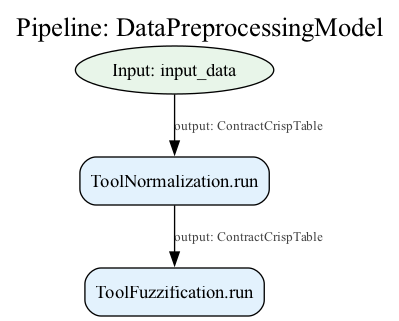
Visualization
The computational graph can be visualized as a directed acyclic graph (DAG)
showing component connections and data flow. By using .visualize(), the graphical
representation facilitates model can be used to debug and architecture verification.
model.visualize()
Understanding Model Architecture
The Model API represents a sophisticated abstraction layer that transforms intuitive object-oriented code into optimized execution graphs. Understanding its internal architecture is crucial for building complex analysis workflows and debugging performance issues.
Model-Component Relationship
The Model API builds upon the existing AnalysisComponent foundation, creating a hierarchical architecture where Models serve as high-level orchestrators of component interactions. This relationship enables powerful composition patterns while maintaining clear separation of concerns.
Inheritance and Composition Architecture:
# Base hierarchy
AnalysisComponent (Abstract Base)
├── Individual Components (ToolNormalization, ToolFuzzification, etc.)
└── Model (High-level Orchestrator)
    ├── Custom Models (Your implementations)
    └── Nested Models (Models containing other Models)
The Model class inherits from AnalysisComponent, making it compatible with the
broader component ecosystem while adding specialized capabilities for workflow
orchestration and symbolic execution.
Automatic Component Registration:
When you assign an AnalysisComponent to a Model attribute, it’s automatically
registered as a submodule through the overridden __setattr__ method:
class DataAnalysisModel(Model):
    def __init__(self):
        super().__init__()
        # Automatic registration via __setattr__ override
        self.normalizer = ToolNormalization()    # Registered as submodule
        self.fuzzifier = ToolFuzzification()     # Also registered
        self.aggregator = ToolSimpleAggregation() # Also registered
This registration enables the Model to:
Track all constituent components for serialization and introspection
Apply symbolic tracing to component calls during the build phase
Manage component lifecycle and state consistency
Enable recursive building for nested model architectures
Symbolic Tracing Mechanism
The heart of the Model API is its symbolic tracing system, which captures the
execution pattern of your forward() method without actually running the
computations. This process transforms imperative Python code into declarative
pipeline specifications.
Tracing Process Overview:
Input Symbolization: Method parameters become symbolic placeholders with associated contracts
Call Interception: Component calls are intercepted via monkey patching and recorded as pipeline steps
Dependency Tracking: Data flow dependencies are automatically captured through parameter passing
Graph Construction: The recorded pattern builds an optimized FuzzyPipeline DAG
Implementation Details:
def forward(self, data: ContractCrispTable, weights: ContractWeightVector):
    # During build(), these calls are intercepted:
    normalized = self.normalizer(data)        # Creates: normalizer_step -> data_input
    norm_weights = self.weight_norm(weights)  # Creates: weight_norm_step -> weights_input
    fuzzy_data = self.fuzzifier(normalized)   # Creates: fuzzifier_step -> normalizer_step

    # Multiple inputs to single component
    result = self.aggregator(fuzzy_data, norm_weights)  # Creates: aggregator_step -> [fuzzifier_step, weight_norm_step]
    return result
Tracing Output Visualization:
--- Building FuzzyPipeline for 'DataAnalysisModel'... ---
--- Starting symbolic trace of 'forward' method... ---
  > Tracing call to 'ToolNormalization'...
  > Tracing call to 'ToolWeightNormalization'...
  > Tracing call to 'ToolFuzzification'...
  > Tracing call to 'ToolSimpleAggregation'...
--- Symbolic trace complete. ---
--- FuzzyPipeline for 'DataAnalysisModel' built successfully. ---
Pipeline Generation Process
The symbolic tracing process automatically generates an optimized FuzzyPipeline
that preserves the logical structure of your forward() method while enabling
advanced execution features like step-by-step debugging and intermediate result
access.
Transformation Example:
# Your intuitive forward() method:
def forward(self, data: ContractCrispTable):
    normalized = self.normalizer(data)
    return self.fuzzifier(normalized)

# Equivalent generated pipeline structure:
pipeline = FuzzyPipeline("MyModel")
data_input = pipeline.input("data", contract=ContractCrispTable)
norm_step = pipeline.add(self.normalizer.run, data=data_input)
fuzz_step = pipeline.add(self.fuzzifier.run, data=norm_step)
Advanced Pipeline Features:
The generated pipeline inherits all FuzzyPipeline capabilities:
Parallel Execution: Independent branches execute concurrently
Lazy Evaluation: Steps execute only when their outputs are needed
Intermediate Access: Any step’s output can be retrieved for debugging
Step-by-Step Execution: Iterate through execution for detailed analysis
Contract System Integration
The Model API seamlessly integrates with AxisFuzzy’s contract system, providing compile-time type checking and runtime validation throughout the analysis workflow.
Type Annotation Processing:
def forward(self,
            data: ContractCrispTable,        # Input contract validation
            weights: ContractWeightVector    # Input contract validation
            ) -> ContractFuzzyTable:         # Output contract specification
    # Contracts are automatically validated during build()
    # and enforced during execution
    pass
Contract Validation Flow:
Build-Time Validation: Input contracts are extracted from type annotations and validated against component requirements
Runtime Enforcement: Data flowing through the pipeline is validated at each step to ensure contract compliance
Error Propagation: Contract violations provide clear error messages with step-level granularity
This integration ensures that complex multi-step workflows maintain data integrity and type safety without requiring manual validation code.
Advanced Model Patterns
The Model API’s flexibility enables sophisticated analysis patterns that go beyond simple linear workflows. These advanced patterns leverage the framework’s symbolic tracing and pipeline generation capabilities to create complex, reusable analysis architectures.
Multi-Input Multi-Output Models
Real-world analysis workflows often require processing multiple data sources and producing multiple outputs. The Model API naturally supports these patterns through its flexible parameter handling and return value processing.
Parallel Processing Architecture:
from axisfuzzy.fuzzifier import Fuzzifier
from axisfuzzy.analysis.app.model import Model
from axisfuzzy.analysis.component.basic import (
    ToolNormalization, ToolWeightNormalization,
    ToolFuzzification, ToolSimpleAggregation, ToolStatistics
)
from axisfuzzy.analysis.build_in import (
    ContractCrispTable, ContractWeightVector, ContractStatisticsDict, ContractAny
)

# Define fuzzifier for the model
my_fuzzifier = Fuzzifier(
    mf='gaussmf',
    mtype='qrofn',
    pi=0.2,
    mf_params=[{'sigma': 0.15, 'c': 0.5}]
)

class MultiStreamAnalysisModel(Model):
    def __init__(self):
        super().__init__()
        self.data_normalizer = ToolNormalization(method='min_max')
        self.weight_normalizer = ToolWeightNormalization()
        self.fuzzifier = ToolFuzzification(fuzzifier=my_fuzzifier)
        self.aggregator = ToolSimpleAggregation(operation='mean')
        self.statistical_analyzer = ToolStatistics()

    def get_config(self) -> dict:
        return {
            'data_normalizer': self.data_normalizer.get_config(),
            'weight_normalizer': self.weight_normalizer.get_config(),
            'fuzzifier': self.fuzzifier.get_config(),
            'aggregator': self.aggregator.get_config(),
            'statistical_analyzer': self.statistical_analyzer.get_config()
        }

    def forward(self,
                data: ContractCrispTable,
                weights: ContractWeightVector):
        # Parallel processing branches - execute concurrently
        normalized_data = self.data_normalizer(data)
        normalized_weights = self.weight_normalizer(weights)

        # Sequential processing on normalized data
        fuzzy_data = self.fuzzifier(normalized_data)
        statistical_summary = self.statistical_analyzer(normalized_data)

        # Multi-input aggregation using normalized data and weights
        final_scores = self.aggregator(normalized_data)

        # Multiple outputs as dictionary
        return {
            'scores': final_scores,
            'fuzzy_representation': fuzzy_data,
            'statistical_summary': statistical_summary,
            'normalized_weights': normalized_weights
        }
Benefits of Multi-I/O Patterns:
Parallel Execution: Independent input processing branches execute concurrently
Flexible Output Access: Consumers can access specific outputs without recomputing the entire workflow
Intermediate Result Inspection: All processing stages remain accessible for debugging and analysis
Non-Linear Data Flow Patterns
The Model API excels at handling complex, non-linear data flows that mirror real-world analysis requirements. These patterns include branching, merging, conditional processing, and iterative refinement.
Branching and Merging Workflows:
class BranchingAnalysisModel(Model):
    def __init__(self):
        super().__init__()
        self.preprocessor = ToolNormalization(method='min_max')
        self.statistical_branch = ToolStatistics()
        self.fuzzy_branch = ToolFuzzification(fuzzifier=my_fuzzifier)
        self.aggregator_branch = ToolSimpleAggregation(operation='mean')

    def get_config(self) -> dict:
        return {
            'preprocessor': self.preprocessor.get_config(),
            'statistical_branch': self.statistical_branch.get_config(),
            'fuzzy_branch': self.fuzzy_branch.get_config(),
            'aggregator_branch': self.aggregator_branch.get_config()
        }

    def forward(self, data: ContractCrispTable):
        # Common preprocessing
        preprocessed = self.preprocessor(data)

        # Multiple analysis branches from single input
        statistical_features = self.statistical_branch(preprocessed)
        fuzzy_features = self.fuzzy_branch(preprocessed)
        aggregated_scores = self.aggregator_branch(preprocessed)

        # Return multiple analysis results
        return {
            'statistical_summary': statistical_features,
            'fuzzy_representation': fuzzy_features,
            'aggregated_scores': aggregated_scores,
            'preprocessed_data': preprocessed
        }
Conditional Processing Patterns:
class ConditionalAnalysisModel(Model):
    def __init__(self):
        super().__init__()
        self.preprocessor = ToolNormalization()
        self.detailed_analyzer = ToolStatistics()
        self.fast_analyzer = ToolSimpleAggregation(operation='mean')
        self.default_analyzer = ToolSimpleAggregation(operation='sum')

    def get_config(self) -> dict:
        return {
            'preprocessor': self.preprocessor.get_config(),
            'detailed_analyzer': self.detailed_analyzer.get_config(),
            'fast_analyzer': self.fast_analyzer.get_config(),
            'default_analyzer': self.default_analyzer.get_config()
        }

    def forward(self, data: ContractCrispTable, analysis_mode: ContractAny):
        preprocessed = self.preprocessor(data)

        # Note: Conditional logic is captured during symbolic tracing
        # The pipeline will contain all possible paths
        if analysis_mode == "comprehensive":
            detailed_features = self.detailed_analyzer(preprocessed)
            return detailed_features
        elif analysis_mode == "fast":
            return self.fast_analyzer(preprocessed)
        else:
            return self.default_analyzer(preprocessed)
Important Note: Conditional logic in forward() methods is captured during
symbolic tracing. The generated pipeline includes all possible execution paths,
with runtime decisions determining which path to execute.
Nested Model Composition
One of the Model API’s most powerful features is its support for hierarchical composition, where models can contain other models as components. This enables building complex analysis workflows from simpler, reusable building blocks.
Hierarchical Model Architecture:
from axisfuzzy.fuzzifier import Fuzzifier
from axisfuzzy.analysis.app.model import Model
from axisfuzzy.analysis.component.basic import (
    ToolNormalization,
    ToolFuzzification,
    ToolSimpleAggregation,
    ToolWeightNormalization
)
from axisfuzzy.analysis.build_in import (
    ContractCrispTable,
    ContractWeightVector,
    ContractFuzzyTable
)

# Create a simple fuzzifier for demonstration
# Using Gaussian membership function with q-rung orthopair fuzzy numbers
my_fuzzifier = Fuzzifier(
    mf='gaussmf',                    # Gaussian membership function
    mtype='qrofn',                   # q-rung orthopair fuzzy number
    q=3,                             # q parameter for qrofn
    mf_params={'sigma': 0.15, 'c': 0.5}  # Gaussian parameters
)

class DataPreprocessingModel(Model):
    def __init__(self):
        super().__init__()
        self.normalizer = ToolNormalization(method='z_score')
        self.statistics = ToolStatistics()  # For data quality assessment

    def get_config(self) -> dict:
        return {
            'preprocessing_type': 'standard',
            'normalizer': self.normalizer.get_config(),
            'statistics': self.statistics.get_config()
        }

    def forward(self, data: ContractCrispTable):
        # Simple preprocessing pipeline
        normalized_data = self.normalizer(data)
        return normalized_data

class FuzzyAnalysisModel(Model):
    def __init__(self, fuzzifier=None):
        super().__init__()
        # Use the predefined fuzzifier if none provided
        if fuzzifier is None:
            fuzzifier = my_fuzzifier
        self.fuzzifier = ToolFuzzification(fuzzifier=fuzzifier)
        self.aggregator = ToolSimpleAggregation(operation='mean')

    def get_config(self) -> dict:
        return {
            'analysis_type': 'fuzzy',
            'fuzzifier': self.fuzzifier.get_config(),
            'aggregator': self.aggregator.get_config()
        }

    def forward(self, data: ContractCrispTable, weights: ContractWeightVector):
        # Convert to fuzzy representation
        fuzzy_data = self.fuzzifier(data)
        # Aggregate the crisp data using weights information
        aggregated_scores = self.aggregator(data)
        return {
            'fuzzy_data': fuzzy_data,
            'aggregated_scores': aggregated_scores
        }

class CompleteAnalysisWorkflow(Model):
    def __init__(self, fuzzifier=None):
        super().__init__()
        # Use the predefined fuzzifier if none provided
        if fuzzifier is None:
            fuzzifier = my_fuzzifier
        # Nested models as components - automatic registration
        self.preprocessing = DataPreprocessingModel()
        self.analysis = FuzzyAnalysisModel(fuzzifier)
        self.weight_normalizer = ToolWeightNormalization()

    def get_config(self) -> dict:
        return {
            'workflow_type': 'complete_analysis',
            'preprocessing_config': self.preprocessing.get_config(),
            'analysis_config': self.analysis.get_config(),
            'weight_normalizer': self.weight_normalizer.get_config()
        }

    def forward(self, raw_data: ContractCrispTable, weights: ContractWeightVector):
        # Models calling other models - creates nested pipeline structure
        preprocessed_data = self.preprocessing(raw_data)
        normalized_weights = self.weight_normalizer(weights)
        analysis_results = self.analysis(preprocessed_data, normalized_weights)
        return analysis_results
Example Usage:
# Example usage
data = pd.DataFrame({'A': [1, 2, 3], 'B': [4, 5, 6]})
weights = np.array([0.6, 0.4])

# Create model instances (fuzzifier is automatically used)
fuzzy_model = FuzzyAnalysisModel()
complete_workflow = CompleteAnalysisWorkflow()
After executing complete_workflow.summary(), we can see the model architecture containing
the nested pipeline.
complete_workflow.summary()
output:
Model: "CompleteAnalysisWorkflow"
==============================================================================================================================
Layer (type)                        Input Contracts                                   Output Contracts
------------------------------------------------------------------------------------------------------------------------------
Input: raw_data                     -                                                 ContractCrispTable
Input: weights                      -                                                 ContractWeightVector
DataPreprocessingModel              ContractCrispTable                                ContractCrispTable
└─ ToolNormalization              ContractCrispTable                                ContractCrispTable
ToolWeightNormalization             ContractWeightVector                              ContractNormalizedWeights
FuzzyAnalysisModel                  ContractCrispTable, ContractWeightVector          ContractFuzzyTable, ContractWeightVector
└─ ToolFuzzification              ContractCrispTable                                ContractFuzzyTable
└─ ToolSimpleAggregation          ContractCrispTable                                ContractWeightVector
------------------------------------------------------------------------------------------------------------------------------
Total layers: 3 (including 2 nested model(s) with 3 sub-layers)
==============================================================================================================================
Nested Model Benefits:
Modularity: Each model can be developed, tested, and reused independently
Hierarchical Debugging: Issues can be isolated to specific model levels
Flexible Composition: Models can be recombined in different configurations
Recursive Building: The framework automatically handles nested model building
Pipeline Generation for Nested Models:
When building nested models, the framework:
Recursively builds all nested models first
Integrates nested pipelines into the parent model’s execution graph
Optimizes the combined pipeline for efficient execution
Maintains clear boundaries for debugging and introspection
This architecture enables building sophisticated analysis systems from simple, composable components while maintaining the intuitive programming model that makes the Model API accessible to developers.
Model Lifecycle and Management
Model Serialization and Persistence
Models support complete serialization for reproducibility and deployment. The serialization system captures model architecture, configuration, and all nested components, enabling exact reconstruction.
Saving and Loading Models:
# Save model configuration and state
model.save("my_analysis_model.json")

# Restore model from saved configuration
loaded_model = ComplexAnalysisModel.load("my_analysis_model.json")
loaded_model.build()  # Must rebuild after loading

# Now ready for use
results = loaded_model.run(data, weights)
Custom Serialization:
Every model must implement get_config() for proper serialization:
class CustomModel(Model):
    def __init__(self, layers=3, activation='relu'):
        super().__init__()
        self.layers = layers
        self.activation = activation

    def get_config(self):
        return {
            'layers': self.layers,
            'activation': self.activation
        }
Model Visualization and Debugging
Models provide comprehensive visualization capabilities through the underlying FuzzyPipeline system, enabling inspection of data flow and computational graphs.
Visualization and Summary:
# Visualize the complete computational graph
model.visualize(save_path="model_graph.png")

# Print detailed model structure
model.summary()

# Step-by-step debugging
for step_result in model.step_by_step(data, weights):
    print(f"Step: {step_result.step_name}")
    print(f"Output: {step_result.output}")
Performance Optimization
Model performance can be optimized through several strategies, focusing on computational efficiency and memory management.
Optimization Strategies:
# Build-once, run-many pattern
model = MyModel()
model.build()  # One-time compilation cost

# Efficient repeated execution
for data_batch in data_batches:
    result = model(data_batch)

# Memory-efficient execution
results = model.run(data, return_intermediate=False)
Component-Level Optimization:
# Use efficient components for large datasets
class OptimizedModel(Model):
    def __init__(self):
        super().__init__()
        self.normalizer = ToolNormalization(
            method='min_max',
            axis=0,  # Vectorized operations
            inplace=True  # Reduce memory usage
        )
Error Handling and Troubleshooting
The Model system provides comprehensive error handling and debugging capabilities to help identify and resolve issues quickly.
Common Error Patterns:
# Model not built before execution
try:
    result = model(data)
except RuntimeError as e:
    print("Remember to call model.build() first!")

# Contract validation errors
try:
    model.run(invalid_data)
except ContractValidationError as e:
    print(f"Contract validation failed: {e}")
    print(f"Expected: {e.expected_contract}")
Debugging Strategies:
# Enable detailed logging for troubleshooting
import logging
logging.getLogger('axisfuzzy.analysis').setLevel(logging.DEBUG)

# Validate model state
if not model.built:
    raise RuntimeError("Model must be built before use")

# Use step-by-step execution to isolate issues
iterator = model.step_by_step(data)
for step in iterator:
    print(f"Successfully executed: {step.step_name}")
Best Practices:
Always call
model.build()before executionUse
model.summary()to inspect model structureValidate contracts independently before model integration
Enable debug logging for complex troubleshooting scenarios
Integration with Analysis Ecosystem
Component System Integration
The Model API seamlessly integrates with AxisFuzzy’s comprehensive analysis ecosystem, providing unified access to all framework components and enabling sophisticated analytical workflows.
Built-in Component Support:
from axisfuzzy.analysis.component.basic import (
    ToolNormalization, ToolFuzzification, ToolSimpleAggregation
)

class IntegratedModel(Model):
    def __init__(self):
        super().__init__()
        self.normalizer = ToolNormalization(method='min_max')
        self.fuzzifier = ToolFuzzification(fuzzifier=my_fuzzifier)
        self.aggregator = ToolSimpleAggregation(operation='mean')
Custom Component Integration:
class CustomProcessor(AnalysisComponent):
    def __init__(self, threshold=0.5):
        self.threshold = threshold

    def get_config(self):
        return {'threshold': self.threshold}

    def run(self, data):
        return self.process_with_threshold(data)

class ModelWithCustomComponent(Model):
    def __init__(self):
        super().__init__()
        self.custom = CustomProcessor(threshold=0.7)
Pandas Integration:
import pandas as pd

# DataFrames automatically gain fuzzy analysis capabilities
df = pd.DataFrame(data)
results = df.fuzzy.apply_model(model, weights=weights)
Contract-Driven Type Safety
The Model API leverages AxisFuzzy’s contract system to provide compile-time and runtime type safety, ensuring robust and reliable analytical pipelines.
Type Validation:
def forward(self, data: ContractCrispTable,
            weights: ContractWeightVector) -> ContractFuzzyTable:
    # Contract compatibility verified during build()
    normalized = self.normalizer(data)
    return self.fuzzifier(normalized)

# Runtime validation with contract decorators
@contract
def custom_component(input_data: ContractCrispTable) -> ContractFuzzyTable:
    return fuzzify_data(input_data)
Custom Contracts:
class CustomDataContract(ContractCrispTable):
    def validate(self, data):
        super().validate(data)
        if data.shape[1] < 3:
            raise ValueError("Data must have at least 3 columns")
FuzzyPipeline Interoperability
Models and FuzzyPipelines are fully interoperable, enabling flexible composition and reuse of analytical components.
Pipeline Access and Composition:
model = ComplexAnalysisModel()
model.build()

# Access the generated pipeline directly
pipeline = model.pipeline
pipeline.visualize(layout='hierarchical')

# Embed models within larger pipelines
meta_pipeline = FuzzyPipeline("meta_analysis")
input_data = meta_pipeline.input("raw_data", contract=ContractCrispTable)

model_output = meta_pipeline.add(
    model.run,
    data=input_data,
    display_name="ComplexAnalysis"
)
Nested Model Architecture:
class HierarchicalModel(Model):
    def __init__(self):
        super().__init__()
        self.preprocessing_model = DataPreprocessingModel()
        self.analysis_model = FuzzyAnalysisModel()

    def forward(self, data):
        preprocessed = self.preprocessing_model(data)
        return self.analysis_model(preprocessed)
Extension and Customization
The Model API provides extensive extension points for customization and domain-specific adaptations.
Custom Model Base Classes:
class TimeSeriesModel(Model):
    """Base class for time series fuzzy analysis."""

    def __init__(self, window_size=10):
        super().__init__()
        self.window_size = window_size
        self.temporal_processor = TemporalProcessor(window_size)

    def get_config(self):
        return {'window_size': self.window_size}
Contract Extensions:
class FinancialDataContract(ContractCrispTable):
    """Contract for financial data validation."""

    required_columns = ['price', 'volume', 'timestamp']

    def validate(self, data):
        super().validate(data)
        for col in self.required_columns:
            if col not in data.columns:
                raise ValueError(f"Missing required column: {col}")
Plugin Architecture:
# Register custom components for automatic discovery
from axisfuzzy.analysis.registry import ComponentRegistry

@ComponentRegistry.register('custom_domain')
class DomainSpecificComponent(AnalysisComponent):
    pass
Advanced Customization:
class OptimizedModel(Model):
    def build(self):
        super().build()
        self._apply_domain_optimizations()

    def _apply_domain_optimizations(self):
        # Domain-specific pipeline optimizations
        pass
Conclusion
The Model API represents a significant advancement in fuzzy data analysis workflow construction, transforming complex pipeline orchestration into intuitive, object-oriented programming patterns. By abstracting away the intricacies of dependency management and execution optimization, it enables developers to focus on the analytical logic rather than infrastructure concerns.
Key advantages of the Model API include:
Intuitive Development Experience: The PyTorch-inspired design makes complex fuzzy analysis workflows as natural as writing regular Python classes, significantly reducing the learning curve for new developers.
Automatic Optimization: Symbolic tracing and pipeline generation ensure optimal execution performance without requiring manual optimization efforts from developers.
Seamless Integration: Deep integration with AxisFuzzy’s component system, contract validation, and pipeline infrastructure provides a cohesive development experience across the entire framework.
Production-Ready Scalability: Built-in serialization, debugging capabilities, and performance monitoring make models suitable for both research prototyping and production deployment.
The Model API bridges the gap between research flexibility and production reliability, enabling teams to build sophisticated fuzzy data analysis systems that are both maintainable and performant. As you continue exploring AxisFuzzy’s capabilities, the Model API will serve as your primary interface for constructing complex analytical workflows with confidence and clarity.